
SanctionsKit research · September 2026
What structured sanctions records tell us about dates and names
An analysis of 19,452 OFAC SDN records and 6,339 UK Sanctions List records: date-of-birth precision, aliases and source-defined identifiers, with methods and aggregate data.
On this page
Two official snapshots. A narrow, practical question.
Which identifying fields are populated in official sanctions XML, and how precisely are they expressed? SanctionsKit examined 19,452 OFAC SDN records and 6,339 UK designation records captured on 30 September 2026. The unit is a source record, not a unique person or organization. The files cover different populations and regimes; their percentages are not a ranking of the sources.
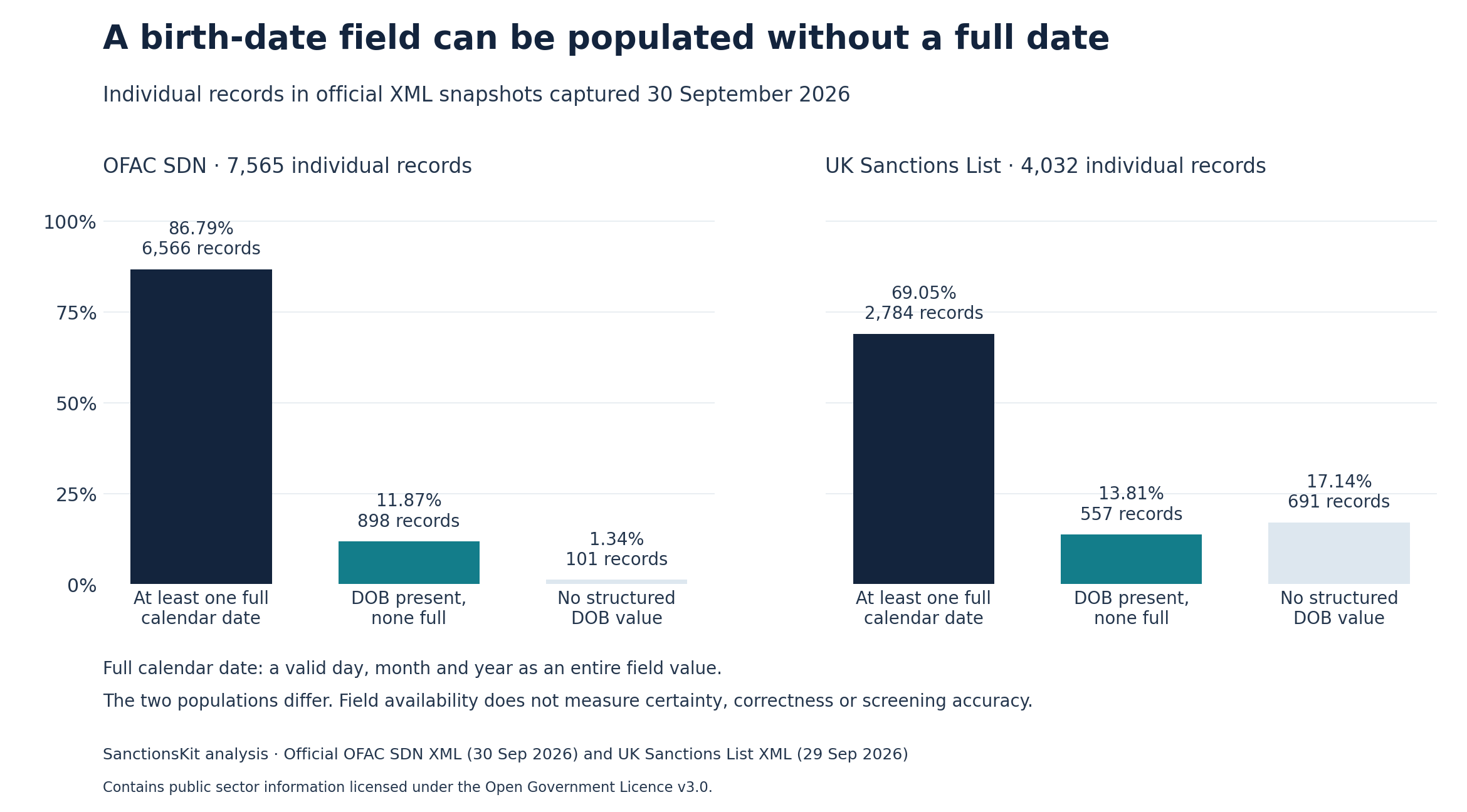
Among individual records, 13.21% in the OFAC snapshot and 30.95% in the UK snapshot had no full calendar value in their structured date-of-birth fields. Most OFAC records in that category still contained partial or otherwise non-full date information. Separately, the UK source distinguishes aliases from primary-name variations. Preserving that distinction changes the names an integration can expose for review.
This study measures structured-field availability at one point in time, not screening accuracy. Download the research package for the report, methodology, aggregate data, source hashes, analysis code and figures. It contains no original source records.
A populated birth-date field can still be partial
We classified each individual record once, based on all of its structured DOB values. A full calendar value must contain a valid day, month and year as an entire value. A year, a range or an approximate-date expression does not qualify. This definition measures the field format; it does not establish that a stated date is certain or correct.
A record with both a year-only value and a full date belongs to the full-calendar category. A year-only value can still be useful: treating it as a precise birthday invents specificity, while treating it as empty discards information. This is an implementation implication of the definitions, not a measured improvement in match performance.
| DOB category | OFAC SDN (7,565 records) | UK list (4,032 records) |
|---|---|---|
| At least one full calendar value | 6,566 (86.79%) | 2,784 (69.05%) |
| DOB present, no full calendar value | 898 (11.87%) | 557 (13.81%) |
| No qualifying structured DOB value | 101 (1.34%) | 691 (17.14%) |
Name categories change the answer
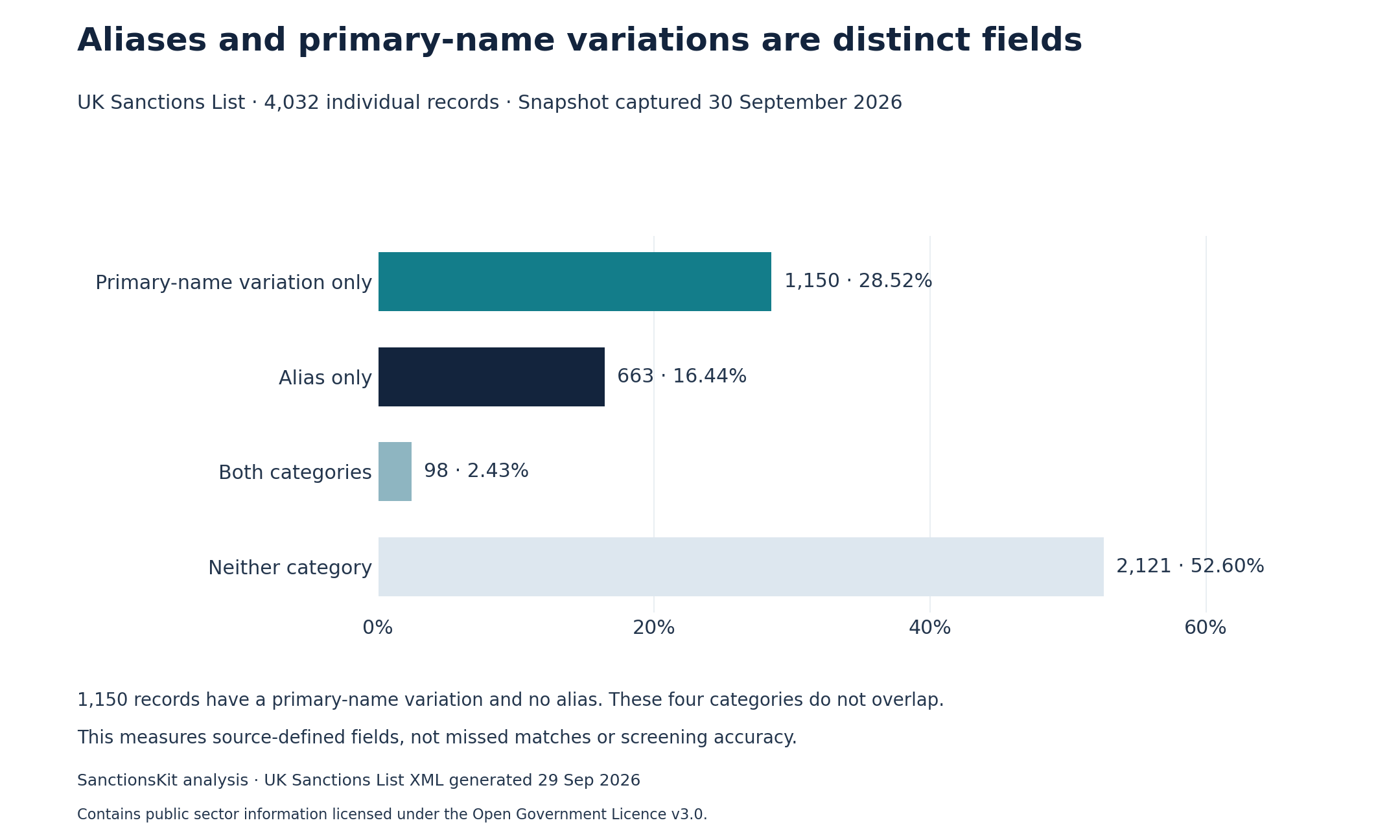
The UK source publishes aliases and primary-name variations as different categories. Among its 4,032 individual records, 761 had an alias and 1,248 had a primary-name variation. Because 98 records had both, the union was 1,911 records, or 47.40%. Adding the two separate counts would double-count the overlap.
An integration that reads only the alias category would not expose primary-name variations for 1,150 individual records that have a variation but no alias. That describes the structured names available to that integration. It is not an estimate of missed sanctions matches.
OFAC's legacy XML has a different alias structure. At least one populated alias appeared on 4,298 individual records (56.81%), including entries marked a.k.a., f.k.a. or n.k.a. That is not the same category definition as the UK alias field.
| Name category | Records | Share of 4,032 |
|---|---|---|
| At least one alias | 761 | 18.87% |
| At least one primary-name variation | 1,248 | 30.95% |
| At least one of either type | 1,911 | 47.40% |
Document fields need equally careful labels
A passport-number field was populated on 2,103 OFAC individual records (27.80%) and 587 UK individual records (14.56%). These figures do not count every possible identity document, validate a number or establish that a passport is current. They do not imply that other identifiers are absent.
In particular, OFAC's general idList also carries attributes such as gender, websites and sanctions information. Its presence is not a sound substitute for counting passport entries. The analysis selects passport-typed entries with a populated number, as specified in the methodology.
For sanctions screening software, the practical implication is to preserve source labels and partial values. Empty, partial, multiple and fully formatted values are distinct states that deserve explicit handling and human review.
Methodology and evidence
This is a census of two official XML files, not a sample or screening benchmark. The OFAC file reports a publication date of 30 September 2026; the UK file reports a generation date of 29 September 2026. Both were retrieved on 30 September at approximately 19:19:59 UTC. A file date is publisher metadata, not a claim that every record changed on that date.
Each metric counts records with at least one qualifying value, divided by all records of the applicable source and entity type. Whitespace and explicit placeholder values are handled consistently. Free-text remarks are not mined for additional facts. Records are not matched or deduplicated across sources. There is no combined quality score.
Read the complete methodology, aggregate CSV, JSON results and source manifest. The analysis code verifies pinned SHA-256 hashes before calculating. Synthetic parser tests cover partial dates, invalid dates, multiple DOB values, placeholders and field typing.
Original official files are retained privately for audit and are not redistributed here. Download URLs can change their content. Exact reproduction needs the matching snapshot bytes; the public hashes verify an input version but do not supply historical data. This is a reproducible method with a pinned private evidence archive, not a claim that historical raw data is publicly hosted.
Use and cite this research
Suggested citation: SanctionsKit (2026), What structured sanctions records tell us about dates and names, 30 September 2026. Link to this report and identify the snapshot date when quoting a finding. Keep source names, record denominators and field definitions with any percentages.
The complete research package includes editable SVG figures, PNG figures, the report and reproduction files. Individual PNG figures are available as DOB precision and UK name categories. Preserve the figure attribution and its limitations.
Contains public sector information licensed under the Open Government Licence v3.0. Analysis by SanctionsKit. Independent work; no government endorsement. Original records, narratives, logos and seals are not republished.
These findings do not measure source correctness, list completeness, screening accuracy, false positives, false negatives, legal compliance, ownership restrictions or SanctionsKit's production coverage. One snapshot per source cannot establish a trend. Read the coverage limitations before applying list-screening results to a real-world decision.